Wednesday, June 10, 2015

Summer 2015 Conference in Portland, Oregon


 A Public Art Conference
  Sponsored by the North American Visual Arts Section of the School of Spiritual Science     

Location:
Portland Waldorf High School
2300 SE Harrison, Milwaukie, Oregon 97222


Today we have passed and are living through the 100-year anniversary of the inauguration of an anthroposophical artistic work, begun by the spiritual initiate Rudolf Steiner in 1907 in Germany and continued through the design and creation of the two Goetheanum buildings in Switzerland. Steiner himself pointed to the need for renewing, if not transforming, an initiative after about 100 years (3 x 33 1/3 year periods relating to a Christic rhythm), lest its vitality and relevance fade away. Many feel that it is time to revisit and hopefully revitalize, expand, deepen, and transform this artistic work so that it can continue its further development into the future. We hope this conference will be one step in that direction. 

Some of our questions: Is there such a thing as “anthroposophical art” or “anthroposophical style”? Is what is most essential about practicing a visual art out of anthroposophical inspiration a particular appearance or a medium used in certain ways? Or is it adherence to certain principles, ideals, and “rules” that is most important? Or is it more a matter of particular methods and manners of creatively working? How can we take into account the further development of both humanity and the visual arts since the time of Rudolf Steiner? How can the work of artists serve present and future human evolution?

It is likely that Rudolf Steiner would have had other things to say and would have demonstrated other approaches to art had he lived long enough for artists to approach him with further questions. Consider the dramatic difference in outer appearance of the two Goetheanum buildings that he designed in Switzerland.

If as artists we aspire to serve our fellow human beings and the larger cause of human evolution, then our study of Rudolf Steiner’s own artwork is only one starting point. If human consciousness is evolving, even within the span of a hundred years, then we need to carefully observe the soul-spiritual forces and trends at work in human and world evolution up to the present.

As we live with these questions, the practice of our art will become less a form of self-expression and more a path of spiritual inquiry and research. We will focus on the present and future of visual arts practice created out of anthroposophical inspiration.

 Conference Schedule

Friday, July 31

5:00 – "First Class Conversation: The mantra of Lesson 17 and the transformation of substance. Introduction by Bert Chase, and reflections on the theme by the members. 
(must bring blue card)

6:00 – Dinner

7:30 pm – Listening Bowls Practice
Led by Carrie Gibbons
Entering into this daily practice, as an aid to our conversations on the theme, we will attempt to create a shared space where together we can practice interest in the other person exploring our theme.

7:50 pm – Art in Service of Human Evolution: The Cultivation of “Artistic Feeling”
Introduction by Michael Howard
By deepening our understanding and experience of Rudolf Steiner’s contribution to the visual arts, we will enhance rather than diminish our creative freedom. We can start by asking how the elements of Steiner’s art serve the spiritual needs of humanity in our time. A certain approach to this question can lead to an experience of new capacities awakening in me vital to my humanity. These new capacities fostered by working anthroposophically with the arts can include perceiving and working with the living etheric forces; developing the free thinking, feeling, and willing of the spiritual self; and developing empathy and love, with a resulting capacity to develop genuine community. Such explorations lead one to feel the inner freedom to create authentic and original works of art that are not derivative of Steiner or others.

During the conference after each approximately 30-minute presentation, we will divide into smaller groups for further discussion and conversation, meeting at the end to share with the whole conference the results of the work of each group. How we do this will depend on the numbers of persons participating.

 8:20 – Small Group Discussions
 9:00 – Sharing by Small Groups with the Plenum

 Saturday, August 1


9:00 am – Listening Bowls Practice
Led by Carrie Gibbons

9:15 am Local Artists: Discussion on Interviews
By Patricia Lynch and Carrie Gibbons
Patricia and Carrie will share impressions from interviews conducted with more than 20 regional
visual artists by using a series of questions to explore individuals' practice and understand
what is living in the minds and hearts of artists in this area.

9:45 – Refreshment Break
10:00 – Small Group Discussions
11:30 – Sharing by Small Groups with the Plenum

12:15 – Lunch Break

2:00 pm –  ­ Artistic Workshops
These afternoon workshops will tackle the conference theme in different, more active ways, as it can arise within a particular visual art medium or way of working.

The Middle Path of the Artist...
Led by Patrick Stolfo
Using the clay medium, we will seek an experiential understanding of symbolic, imitative, and the "synthesis of the ideal and the real" expressions in art. Our explorations should serve to inform the 4:30 Saturday conversation.    

A Short Glimpse into the Movement of Color in the First 3 of Rudolf Steiner’s Training Sketches for Painters
Led by Laura Summer
Asked by painter Henni Geck around 1922 to inaugurate a training for painters similar to that for eurythmists, Rudolf Steiner responded with a sequence of 23 color sketches in pastels as “picture seeds” to be re-experienced and re-created by being worked out freely as watercolor paintings as the first steps of a new training for painters. As we learn to work in painting with color as our starting point, these sketches can be our teachers. We will work with watercolor and maybe some other media.
Experiences with Social Sculpture
Led by David Adams and Carrie Gibbons
Working with this relatively new approach to a “social art,” we will engage in a number of artistic, aesthetic, and social processes, including practices to enhance perception, gather or transform substances, and consider movement and archetypal forces.

4:00 – Refreshment Break

4:30 – The Emergence of the True, Living Motif in the Artistic Process
Introduction by Patrick Stolfo.
A presentation of some basic principles of the anthroposophical artistic impulse as articulated by Rudolf Steiner, leading to a discussion on how we find a genuine spiritual essence in our artwork (beyond physical, etheric, and astral levels) between the husks of mere symbolism and imitation. What is the nature and meaning of “semblance” in our art, the forging of the “appearance” of the soul-spirit in the guise of the physical medium?

5:00– Small Group Discussions
5:45 – Sharing by Small Groups with the Plenum

6:00 – Supper Break

7:30 – The Wider Perspective –­ Reflections on Anthroposophical Art
Led by Bert Chase
Thoughts on how this question is being carried within the Visual Arts Section, the relationship of these questions to the working of the Collegium of the School of Spiritual Science in North America, and the interest within the Anthroposophical Society of how artists can speak to our current situation.

8:00 – Small Group Discussions
8:45 – Sharing by Small Groups with the Plenum

 Sunday, August 2


9:00 am – Listening Bowls Practice
Led by Carrie Gibbons

9:15 – The Transformation of Visual Art out of the New Mysteries of Will
Introduction by David Adams.
The transition from the old Mysteries of Wisdom to the new Mysteries of Will is part of a larger evolutionary passage from the Cosmos of Wisdom to the Cosmos of Love that just begins in our Fifth Epoch. In art from the Mysteries of Will it is free initiative in the form of gesture, process, and movement that matter, in relationship to immersive experiences – not, as in past, traditional art, the pictorial visual appearance that can be observed statically. In the will work both dead human souls and the hierarchies, so techniques for relating more consciously to this invisible “will-community” become part of one’s artistic practice, which also acquires a social component.

9:45 – Refreshment Break

10:00 – Small Group Discussions
11:30 – Sharing by Small Groups with the Plenum

12:15  – Lunch Break

2:00 pm – Artistic Workshops
3:30 pm – Closing Plenum Observations and Conversation & Sharing from Workshops

4:30 pm – Conclusion

LINK TO PDF REGISTRATION FORM

LINK TO PDF OF THE CONFERENCE FLYER

LINK TO PDF OF CONFERENCE READING MATERIAL

CONFERENCE FEE: $25.00 Includes snacks and art supplies for workshops


More information by phone in Portland, OR: Carrie Gibbons at (503) 708-8994
More information via email: Christopher Guilfoil  at c.guilfoil@gmail.com


Saturday, March 7, 2015

Summer Art and Craft Immersions in Hawthorne Valley, New York

The Alkion Center at Hawthorne Valley
June 28 – July 3, 2015


Arts and Crafts Immersions: Studio Workshops for Teachers and Artists
Painting/drawing with Martina Angela Müller; clay/wood/stone with Patrick Stolfo;   fiber arts with Candace Christiansen; bookbinding with Lisa Damian
For more information, course descriptions, 
and registration go to:

Tuesday, February 17, 2015

Visual Arts Section at the Goetheanum


THE SOURCES
OF ART II
SECTION CONFERENCE
14 – 17 May 2015
Goetheanum
Dornach, Switzerland

Click here for link to the flyer and more information 


CONTRIBUTORS

Prof. Jochen Breme
Studied Sculpture in Bonn/Alfter. Today Senior Lecturer in Sculpture at the Alanus Hoch- schule für Kunst und Gesellschaft, Bonn/Alfter. Founding member of the Bonn artists group „Rhein & Artig“. www.j-breme.de

Cornelia Falkenhan
Sculpture studies in Bonn/Alfter. Further studies at the HfG Offenbach specialising in stage set and costume design. Works as freelance artist and set designer in Frankfurt am Main.

Martin Gutjahr
Apprenticeship in Pottery, studies in Sculpture and Paining. Freelance artist on the Lake Constance and lecturer at Emerson College in England. www.martingutjahr.zenfolio.com

Dr. Roland Halfen
Studied Philosophy, History of Art and Archeology. Author of numerous books and co-worker at the Rudolf Steiner Archive in Dornach.

Prof. Fritz Marburg
Studies in Sculpture and Art Therapy, past rector of the Art Therapy College, Nürtingen. Art educator and artist in the fields of sculpture and Landart.

Hansjörg Palm
Studied Sculpture at the Alanus Hochschule and Emerson College in England. Today a freelance Video and Performance artist and lecturer at the Freie Kunstschule Munzingen.

Riho Peter-Iwamatsu
Eurythmist. Part of the stage ensemble at the Goetheanum.

Dr. Claudia Schlürmann
Studies in Social Education and Sculpture. Many years experience as art educator and lecturer. 2014 PhD in practical Social Sculpture. Works as freelance artist on the Lake Constance. www.atelier-cds.de

Marianne Schubert
Studied Architecture and Landscape Archtecture. Until 2014 freelance work in building and landscape gardening. Since 2014 Leader of the Visual Art Section at the Goetheanum.

Prof. Peer de Smit
Studied at the Drama Academy in Zürich. Professor for Social Theatre. Rector at the University for Social Arts, Ottersberg near Bremen.
Weidlerkwartet (Weidler String Quartet)
Keen Paasen, Mathilde Krabbe, Violin; Jorien van Tuinen, Viola; Joris Boon, Violoncello 

Jochen Breme:Migration

Monday, January 19, 2015

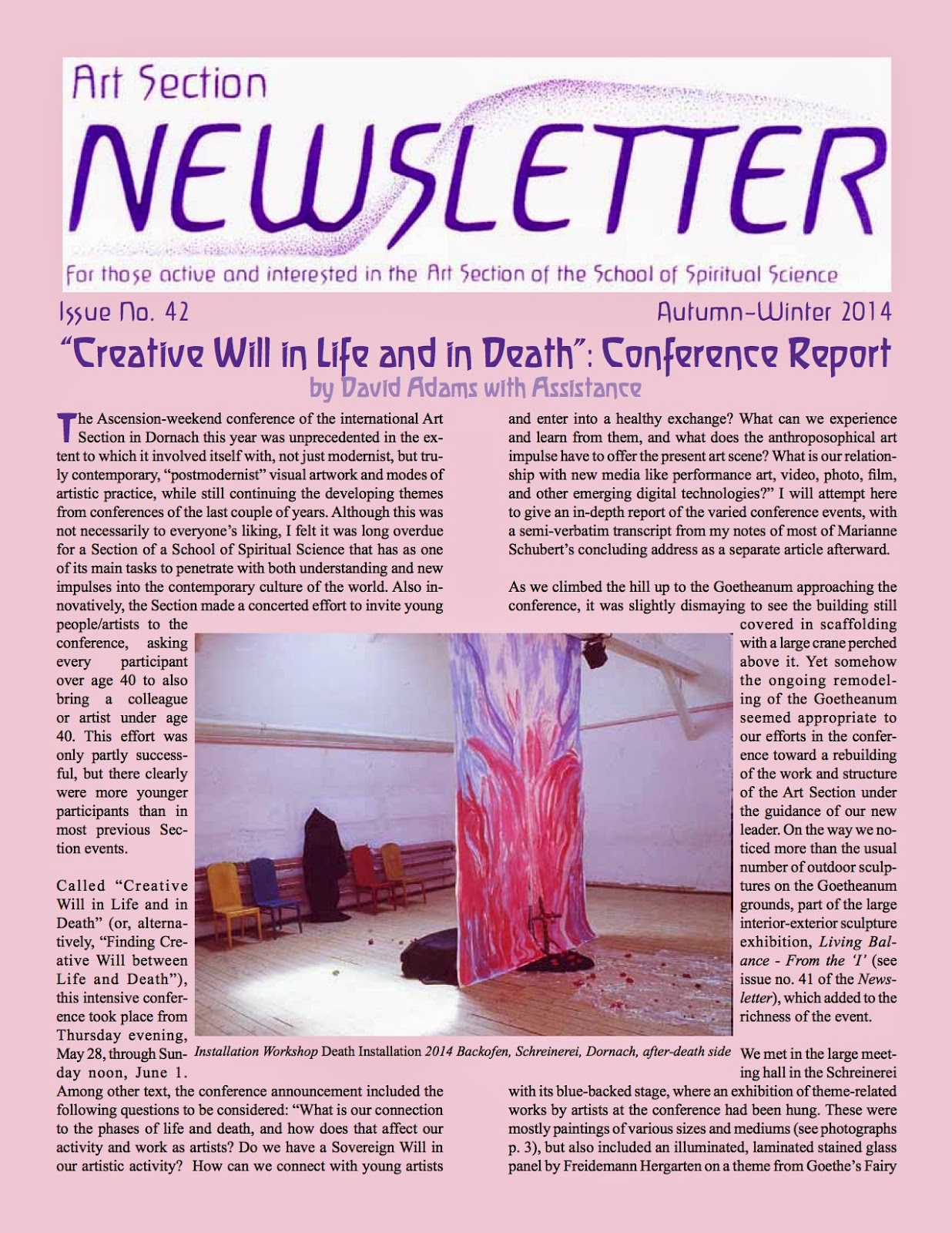
Newsletter #42, Autumn/Winter 2014 Now Posted

Our latest Newsletter is now available to read online. Click here to read.
See subscription information in the right hand column of this blog.
You can now subscribe via PayPal for European subscribers paying in Euros.
There are two subscription types available: Print and Online.


Tuesday, January 13, 2015

Landscape Painting Retreat
August 21thru 25th noon

Experience nature through Color & Form with Jennifer Thomson

Explore Goethe’s Color Wheel as a landscape with veil painting technique. Afternoons create the essence of trees, flowers, mountains & water, in landscape moods with different color exercises inspired by Monet. Some works will develop into finished art.  Composition will be explored. Critique.

 Materials:  gouache paints & charcoal

Work space:  Sun Studio & outdoors into the Sangre de Cristo Mountains to experience Nature through direct observation.

Daily class:  9 am to 4:30 pm
Lunch break:  12:30 to 2:30
Tuition:  $250 includes 4 organic veggie lunches & snacks
Deposit:  $75 nonrefundable, to reserve a space
Supplies:  $35 extra or bring your own (list provided)
Accommodations:  www.crestonecolorado.com      www.crestoneeagle.com
Camping:  5 minutes driving to Sun Studio

Info:  Jennifer Thomson, PO Box 894, Crestone, Colorado 81131, 719-937-7694
www.jenniferthomson.net

Join us in Crestone, Colorado…..August 21-25 noon


2015 August 7 thru 11 Art Retreat
Blue…infinite…..Lustre of the soul…Blue’s character moving inward, lighter on the inside and darker on the periphery.  What happens when other colors interact with blue?  Create inner balance as you experience peacefulness through working with blue.

Mornings:  9am, our color work begins with a given blue study that will develop into a painting over the 5 days. We will practice the veiling technique with watercolor, and motif with various artistic methods.

Our focus in the mornings will be to develop form and motif ‘out of the color’, an approach inspired by Goethe and Steiner that perceives colors as the visible outer garments of invisible forces.

Afternoons:  One afternoon session sketching in charcoal or ink, in Colorado’s magnificent nature. Drawing upon the art of Kandinsky and Franz Marc, we will develop landscape sketches into paintings and explore color exercises inspired by Marc’s animal paintings. We will practice animal gestures with light/dark composition in ink.   Create your own color studies.   Material:  watercolor, gouache, ink, pencil or charcoal

Evening Presentations:  Franz Marc & the Blue Rider group, Artistic presentation Jennifer &Ammi
 Health through Anthroposophy with Philip Incao

Tuition:  $355 includes supplies, plus 5 organic veggie lunches & snacks
Deposit:  $75, nonrefundable, to reserve a space
Accommodations:  B&B, Hotel, Camping www.crestonecolorado.com  www.crestoneeagle.com
Meals:  nearby cafes & organic food stores.
Location:  Sun Studio in Crestone, Colorado

Sign up & info:  Jennifer Thomson, POBox 894, Crestone, Colorado, 81131,
Spend 5 artistic rejuvenation days at the foot of sacred mountains:  Time for mineral hot spring soaks & swims. Hike in the National Forest or Sand dunes National Park or visit Crestone’s spiritual centers.  See wildlife.  Renew yourself and your life path in contemplation and color in nature’s beauty in Crestone 8000ft. Alpine Valley.
Art is, after all, only a trace…like a footprint which shows that one has walked bravely and in great happiness.  Robert Henri


Monday, January 5, 2015

Art Section Newsletter Seeking a New Volunteer Co-Editor.

The Newsletter is looking for a new, volunteer, non-North-American Co-Editor to replace Marion Briggs. Requirements include being an active member of the Art Section, working knowledge of a page layout program (such as Adobe InDesign or maybe Microsoft Publisher) as well as an image-editing program (such as Adobe Photoshop or Photoshop Elements), and being fluent enough in English to edit articles and text (including things like grammar, spelling, punctuation, etc.). If  interested, please contact David Adams at ctrarcht.nccn.net.

Sunday, December 14, 2014


Arts & Consciousness Intensives
January / February, 2015
Rudolf Steiner College


Van James, BFA, San Francisco Art Institute, Hawai'i based artist, author, and teacher; art instructor Honolulu Waldorf School for over 30 years; guest teacher at colleges and schools in Australia, New Zealand, China, India, and the US; chair of the Anthroposophical Society in Hawai'i; editor, Pacifica Journal; author of several books on art and culture including, Ancient Sites of O'ahu; Spirit and Art; The Secret Language of Form; and his latest, Drawing with Hand, Head and Heart.


WEEK l
January 26-29, 2015 8:30 am - 12:30 pm Face Value & Beyond: Experiences in Portraiture with Van James


How is it that the art of the portrait reveals more than an outer appearance? Can the portrait and self-portrait lead to a deeper understanding of our humanity and the self? We will pursue these and other questions in this portrait drawing/painting course which will consider a wide variety of mediums and approaches to the portrait and self-portrait beginning with the stages of children's drawings and the historical developments of portraiture, working towards greater technical refinement and more creative expression. This workshop is for beginners, teachers, and artists alike.

$235 ($185 seniors / students)
 

WEEK ll


February 2-5, 2015 8:30 am - 12:30 pm Mysteries of the Mandala : Awakening Hidden Geometry of the Soul with Van James


Carl Jung said of mandalas: "In accord with the Eastern conception, the mandala symbol is not only a means of expression, but works an effect. It reacts upon its maker. Very ancient magical effects lie hidden in this symbol...the magic of which has been preserved in countless folk customs." This intensive will consider the worldwide significance of mandalas and explore the deeper spiritual-artistic aspects of this unique form through progressively more challenging drawing exercises, including how Rudolf Steiner worked with the mandala principle in meditations, and culminating in the creation of individually themed mandalas. No artistic experience is necessary.$235 ($185 seniors / students)


 Evenings for Teachers, Parents & Others

Drawing with Hand, Head and Heart: Developing the Language of Pictures with Van James.

 Three evening sessions 6:30 - 8:30 pm


Children learn by means of concrete, then symbolic, and finally by abstract knowing. All three forms of learning can be accessed by means of the arts, especially the first two that are most important in primary and elementary education. How can the visual art of drawing teach children to see, learn, and know more fully? These evenings, designed for professional educators, teachers in training, parents, and artists will demonstrate the basic changes that picture-making can reveal appropriate to the stages of child development. All of these evening workshops include drawing by participants, but no experience is necessary.$25 each (seniors / students $20 each)$60 for all three


 The Beginnings of Drawing-The Early YearsTuesday, January 27, 2015, 6:30 - 8:30 pm


This evening workshop will trace the early stages of children's drawing from scribbles to basic figurative representations and demonstrate how such picture-making encourages specific brain patterning and ways of thinking. With lecture-demonstration and hands-on drawing exercises, you will experience how "growing" pictures is the easiest way to teach children (and adults) to draw and is a technique most consistent with the reality of what we actually see in the world. 

Elementary Drawing-After the Nine Year ChangeThursday, January 29, 2015, 6:30 - 8:30 pm


With the changes of pre-adolescence and the middle school years, drawing too begins to change. Greater attention to detail and the challenges of proportion and spatial perspective become important. Drawing from the whole to the parts is replaced by drawing the parts to form the whole. In this workshop, a closer look at these changes will be practiced with attention to figure and object drawing in the fourth, fifth, and sixth grades. 

Further Perspectives-Drawing for the AdolescentTuesday, February 3, 2015, 6:30 - 8:30 pm


At the threshold of adolescence, drawing goes through a further enhancement appropriate to the teenager. Technical drawing and the use of line, which was avoided in the early grades, must now be fully exercised by means of perspective constructions, geometric drawing, and contour line drawing. In addition all the possible drawing techniques can be practiced as counter measures to the limitations of line drawing. The experience of light and darkness is a powerful drawing medium at this age as is the expressive use of color.


 Weekend Mandala Workshop with Van James


Introduction to the Art of Mandalas: A Creative Centering of the Self


Friday, January 30, 6 - 9 pm and Saturday, January 31, 9 am - 4:30 pm


The mandala creates an enclosed "essence container," or sacred space, which traditionally represents the self within the universe. It is an emblematic expression in both Eastern and Western spiritual-artistic traditions used for visualization, self-realization, meditation, and initiation. Hildegard von Bingen, Rudolf Steiner, Carl Jung, and the 14th Dalai Lama, all created mandalas and worked with the remarkable power to fashion a center of positive activity within the greater universe. This workshop will consider the worldwide phenomena of mandalas and explore the practical-artistic aspects of this unique form through drawing exercises, culminating in the creation of one's own individual mandala. No artistic experience is necessary.$110 ($85 seniors / students) Registration opens December 1strudolfsteinercollege.edu/registration  


Rudolf Steiner College 
Reception and Admissions: 916-961-8727 x100
Registration: 916-864-4864 


Monday, September 22, 2014

New Essay by David Adams, 2014

An Overview History of Anthroposophical Visual Arts in the USA
by David Adams, 2014

Rudolf Steiner  Weaving Light


At the turn of the twentieth century a radical spirit
of change began to sweep through the established
forms of visual art. Artists longed to forge new languages
of art working out of pure color and pure form, expressing
the essential, invisible reality of their subjects and not
only an imitation of their outer sensory appearance. Rudolf
Steiner (1861-1925) shared this progressive mood
of absolute reorientation and change among artists in
middle Europe, but he felt that the changes beginning to
manifest required the artist to grow attentive to the world
of the spirit in a newly objective, concrete, and scientific
manner and to develop new means of expression to reveal
something of this world through works of art.

Here is a link to the entire essay with many pictures.
Kula Makua—Adult Waldorf Education Presents:
A Visual Arts Intensive—
Painting and Drawing for Teachers
with Van James

Sunday, June 28 to Friday, July 3, 2015
Honolulu, Hawai’i


A unique six-day drawing and painting retreat for teachers, artists, therapists and parents will take place in Hawai’i this summer from June 28 to July 3, 2015. The course will look at how children first learn to draw and paint and how to best promote these arts with techniques and lessons appropriate to the developmental stages of the child. A Waldorf approach, appropriate to any educational setting, will be utilized with special attention to Rudolf Steiner’s ideas and some of the latest research on child development in connection with the arts.

Due to the special nature of Hawai’i and its spirit of place, these intensive classes will be held mornings only so that participants can have their afternoons free to explore the beauty of the island of O’ahu. The artistic sessions will be held at the Honolulu Waldorf School, MaKai Campus, 5257 Kalaniana’ole Highway, 96821, in an ocean-side art studio. The school is located on a bus route and a selection of restaurants is located directly across the street.

Visual Arts Intensive

Schedule
June 28, Sunday—8:30-10:30am, Drawing for K-2
            10:30-11am, Break
            11am-12:30pm, Painting for K-2nd grade
June 29, Monday—8:30-10:30am, Drawing for 3-4
            10:30-11am, Break
            11am-12:30pm, Painting for 3-4th grade
June 30, Tuesday—8:30-10:30am, Drawing 4-5
            10:30-11am, Break
            11am-12:30pm Painting 4-5th grade
July 1, Wednesday—8:30-10:30am, Drawing 5-6
            10:30-11am, Break
            11am-12:30pm, Painting 5-6th grade
July 2, Thursday—8:30-10:30am, Drawing 7
            10:30-11am, Break
            11am- 12:30pm, Painting 7th grade
July 3, Friday—8:30-10:30am, Drawing 8
            10:30-11am, Break
            11am-12:30pm, Painting 8th grade

The fee of $360 includes two sessions per day for six days, all materials, and refreshments at break times. An early-bird fee of $300 is offered to early registrations until March 1, 2015. Space is limited. All housing and meal arrangements are left up to individuals and are not included or arranged by the Arts Intensive. (Package deals from your own locale, including air, hotel, and car, will likely be the most reasonable option.)

For registration and further details contact art4hawaii@gmail.com or 808-395-1268.

Student Work: